
How to get more leads from your website
Your website gets visitors but few enquiries? Forms, WhatsApp buttons, speed and follow-up: the practical checklist that turns traffic into leads.
By CINEM Team
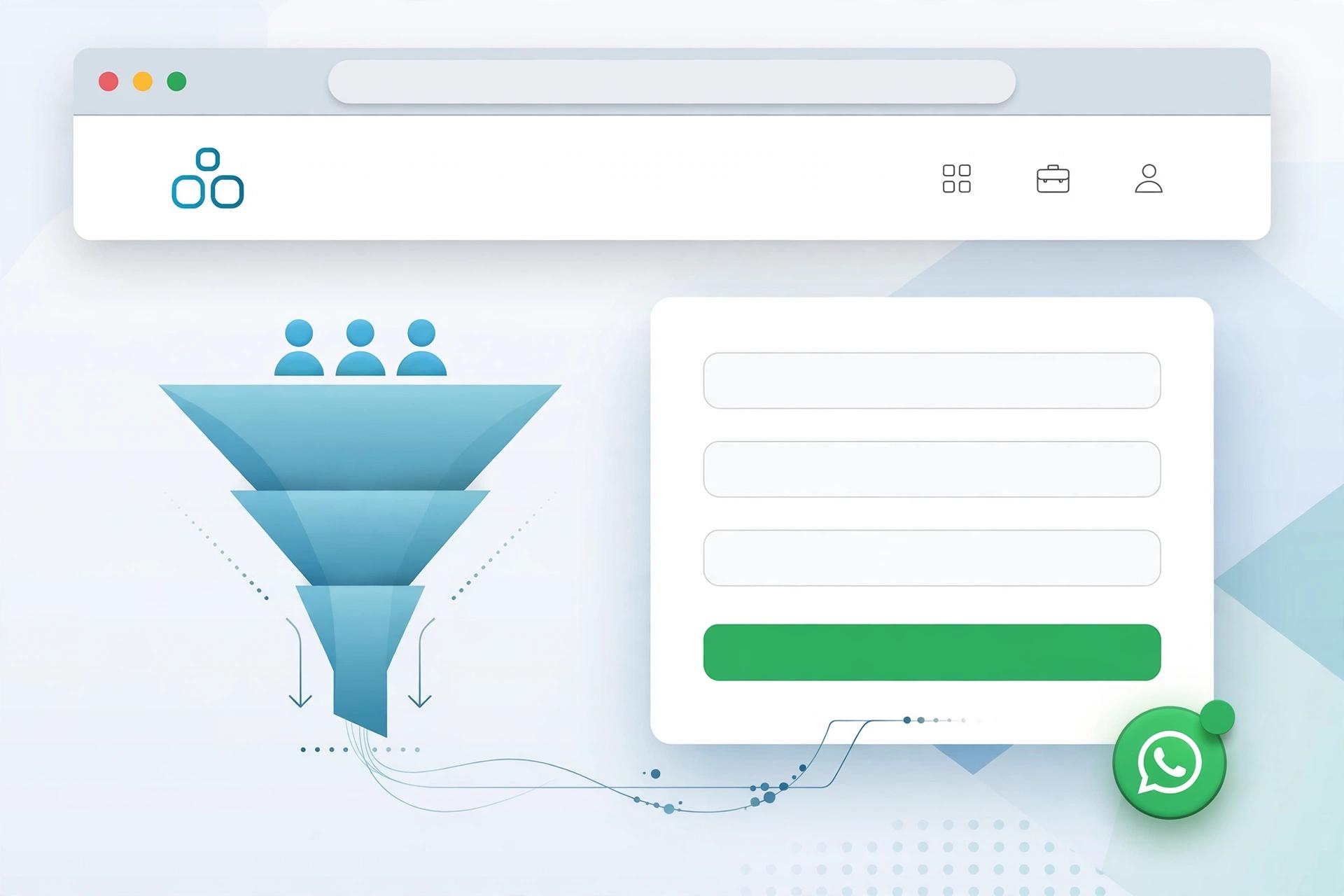
Your website gets visitors. You can see them in the analytics: hundreds of people a month, sometimes thousands. But the phone does not ring, the inbox stays quiet, and the enquiries you do get are mostly the wrong kind. This is the most common website problem in the world, and it is also the most fixable. A website that gets traffic but no leads is not a traffic problem. It is a conversion problem, and it is usually caused by a short list of fixable mistakes: the next step is unclear, the form asks too much, there is no easy way to message you, the site is slow, or nobody follows up. This guide walks through each one, in the order that matters, so you can turn the visitors you already have into enquiries.
The short answer
To get more leads from your website, make one next step obvious on every page, keep your forms short, put a WhatsApp button where visitors can see it, make the site load fast on a phone, and follow up every enquiry within minutes, not days. Most websites fail on two or three of these at once, and fixing them together usually doubles or triples the enquiries from the same traffic. The honest rule is simple: a visitor who cannot see what to do next, or who has to work to contact you, will leave and contact your competitor instead. If your site has no traffic at all, that is a different problem, and our related post How much does SEO cost per month? explains what ranking work costs. If your site is slow, our related post How fast should your website load? Speed, SEO and lost sales explains the speed targets that keep visitors on the page.
Make the next step obvious
The first fix is also the simplest: tell the visitor what to do next, on every page, in words they cannot miss. A visitor arrives with a question, not with patience. They want to know what you do, whether you can help them, what it costs, and how to reach you, in that order, and if any of those answers is hard to find, they leave. Every page should have one clear action, repeated where the eye lands: a button that says Get a quote, Book a consultation, or Message us on WhatsApp, not a vague Learn more that leads nowhere. The homepage should answer the three questions that matter in the first screen: what you do, who it is for, and what to do next. Service pages should end with the same action, not with a paragraph that trails off. And the contact details should be visible, not buried: a phone number, a WhatsApp button and an email address, in the header, on every page. This sounds basic, and it is, which is why it is so often missed. Open your own website on your phone, as a customer would, and count how many seconds it takes to find out how to contact you. If the answer is more than five, you have found your first leak.
Forms that people actually complete
Forms are where most leads die, and the reason is simple: businesses ask for too much, too soon. A visitor who is still deciding does not want to fill in ten fields, upload a file and write an essay. They want to ask a question and get an answer. The rule is to ask for the minimum you need to reply: a name, a way to contact them, and one line about what they need. That is three fields, not ten. Every extra field costs you enquiries, and the fields that cost the most are the ones that feel like a test: budget ranges, detailed project descriptions, and anything marked with a red star that the visitor does not understand. The form should also tell the visitor what happens next: we reply within one business hour, we will call you to confirm, or your quote is on its way. A form that says nothing after it is sent feels like a black hole, and visitors who have been ignored before will not risk it again. Test the form yourself, on your phone, on mobile data, and check that it actually sends, that the reply goes to an inbox someone reads, and that the thank-you message is clear. A form that silently fails is worse than no form at all, because it makes visitors believe they have enquired when nobody has heard them.
WhatsApp: the button that doubles enquiries
For many businesses, the single biggest change is a WhatsApp button. In Pakistan, the UAE, India and much of the world, customers message before they fill in a form. A form feels formal and slow. WhatsApp feels like talking to a person, and it lets the customer ask a question in their own words, send a photo, and get a quick answer. Put a WhatsApp button on every important page, not only on the contact page, and make it open a chat with a pre-written message, so the customer does not have to think about what to type. Answer quickly, because speed is the whole point: a reply in five minutes converts far better than a reply in five hours, and a reply the next day often converts nobody. If your team cannot answer at night or on weekends, a chatbot can: at CINEM, an AI chatbot starts from $999 setup plus $299 per month, and it answers on WhatsApp and on your website, qualifies the enquiry, books appointments, and hands the conversation to your team with the details attached. For businesses whose customers mostly call, an AI calling agent from $1,499 setup plus $399 per month can answer those calls and book appointments when your team is busy. The channel matters less than the speed. A customer who gets an answer in minutes is a customer who stays with you.
Speed and trust: the quiet conversion killers
Two things kill enquiries without anyone noticing: a slow site and a site that looks untrustworthy. Speed first. A site that takes more than three seconds to load on a phone loses a large share of its visitors before they read a word, and every extra second costs more. Compress the images, remove the scripts you do not need, and host the site properly, because a fast site is not a luxury, it is the front door. Trust second. A visitor who is deciding whether to enquire looks for signs that you are real and reliable: real photos of your work, real reviews with names, a clear address and phone number, prices or price ranges instead of the words contact us for pricing, and a professional design that does not look like a template from five years ago. Trust also comes from content: a blog that answers real questions, case studies that show real results, and a site that is clearly maintained, not abandoned. A website that looks neglected tells the visitor that the business behind it is neglected too. If your site is slow or looks tired, fixing that is lead generation, not decoration. At CINEM, Care retainers are $499, $1,499 or $3,999 per month depending on the level of support, and they cover hosting, security, updates, monitoring and ongoing improvement as one service.
Follow-up: the step most businesses skip
The final leak is the one most businesses never see: the enquiries that arrive and are never followed up. Studies of lead response consistently show the same pattern: the business that replies first usually wins, and most enquiries go cold within hours, not days. Yet many businesses reply the next day, or never, because the enquiry went to an inbox nobody checks, or to a form nobody monitors. Fix the plumbing first: every enquiry should go to a place a named person checks, every day, with a clear rule for who replies and how fast. Then fix the follow-up itself. A first reply should arrive within minutes, even if it is only to say we have your message and will call you at a time that suits you. A second message should follow if the customer goes quiet, and a third a few days later, because a customer who enquired once is still a customer, they are just busy. This is where systems earn their money: a chatbot that qualifies and books, a calling agent that answers missed calls, and a lead generation service that keeps new enquiries coming. Our Lead Generation service is $599 per month plus ad spend, and it pairs with a website that converts, because ads that send visitors to a site that leaks enquiries are money thrown away. Fix the site first, then buy the traffic.
Frequently asked questions
Why does my website get traffic but no leads?
Usually because of a short list of fixable problems: the next step is unclear, the form asks too much, there is no WhatsApp button, the site is slow on a phone, or enquiries are not followed up quickly. Fix those five things together and the enquiries from the same traffic usually double or triple.
How many fields should my contact form have?
Three: a name, a way to contact them, and one line about what they need. Every extra field costs you enquiries. Ask for more detail later, in the conversation, once the visitor has already decided to talk to you.
Does a WhatsApp button really bring more enquiries?
For most businesses, yes, often dramatically. Customers message before they fill in a form, especially in Pakistan, the UAE and India. A visible WhatsApp button that opens a chat with a pre-written message removes the effort from contacting you, and effort is what kills enquiries.
How fast should I reply to a website enquiry?
Within minutes, not hours. The business that replies first usually wins, and most enquiries go cold within hours. If your team cannot reply at night, a chatbot from $999 setup plus $299 per month can answer instantly and hand the conversation to your team.
Should I spend on ads if my website does not convert?
No. Fix the website first, then buy the traffic. Ads that send visitors to a site that leaks enquiries waste money. Once the site converts, Lead Generation at $599 per month plus ad spend will bring in far more for the same budget.
If your website gets visitors but few enquiries, the fix is usually smaller than you think. Tell CINEM at hello@cinem.tech what your website does today, where your visitors come from, and how many enquiries you get in a month. We will look at the site the way a customer sees it, find where the leads are leaking, and tell you honestly what to fix first, from a clearer call to action to a chatbot that answers on WhatsApp.